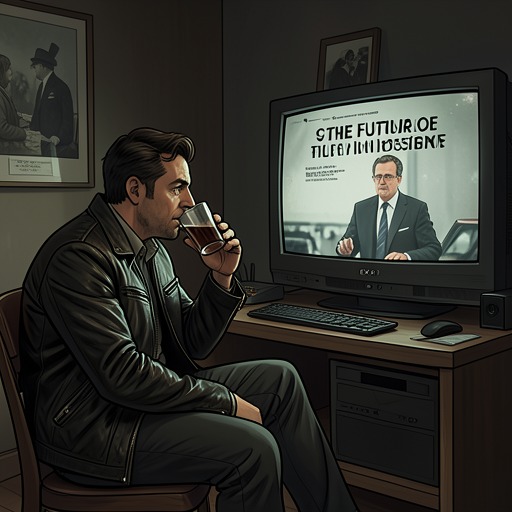
Rick Dalton’s Career Decline
Once Upon a Time in HollywoodRick Dalton’s career decline is the pressure shaping his choices throughout the book: the former star of Bounty Law has spent years treading water, and now his prospects seem to be sinking. The change is more than a loss of work. Rick fears that television and film have fixed him in the public mind as an aging Western actor, useful chiefly as the heavy who gets beaten by the next new hero. Marvin Schwarz gives that fear a professional explanation; playing Caleb DeCoteau in Lancer gives Rick a chance to see that an old image might still be changed.
From television star to uncertain prospect
Rick once had his own series, Bounty Law, but by the time Marvin Schwarz meets with him, that success belongs to the past. Rick has been working for more than ten years and believes he has become a failure who helped run his own career into the ground. His judgment is not simply that his projects have disappointed him: he can still point to performances in which he thinks his potential showed, particularly opposite strong guest stars such as Bronson, Coburn, Meeker, and Vic Morrow. He also recalls promising pairings in films, including Tanner, McCluskey, and Hellfire, Texas. In his view, however, the studio repeatedly placed him alongside older performers whose careers were already fading, while a more distinguished co-star might have brought out a different side of him.
Rick places part of the responsibility on Jennings Lang at Universal, but he does not let himself off the hook. He says he also squandered his potential, especially by losing a fourth season of Bounty Law. He had wanted to leave television and become a movie star, hoping to follow Steve McQueen’s path. During the third season, he admits, he was difficult and made clear that he believed he had better opportunities elsewhere. He now expects Screen Gems and the show’s producers to hold a grudge. His regret is sharpened by the recognition that a successful fourth season might have allowed the cast and crew to continue working and part on better terms.
Marvin Schwarz’s diagnosis
Marvin’s meeting with Rick, arranged at the request of Rick’s regular agent, Sid, puts the actor’s anxiety into the language of the business. Marvin represents established American performers to foreign film industries, including those in Italy, Germany, Japan, and the Philippines. He presents his client list as proof that his work is not limited to selling has-beens: he represents Hollywood royalty. For Rick, this is at once reassuring and unsettling. The same international market that offers him a job can also define the terms on which he is wanted.
Marvin explains the danger of repeatedly casting a former television lead as a villain who loses the fight. A network can use a recognizable actor from a canceled series to establish a newer performer’s credentials; the audience then watches the rising star defeat the familiar face. Marvin imagines Rick becoming a recurring punching bag for successive newcomers, from Bingo Martin to Ron Ely and Bob Conrad. The physical contest is staged, but its effect on a performer’s public identity is not. Rick understands that audiences may remember the defeat more readily than the stature he brought to the role. Marvin’s account makes the decline feel cumulative: each loss can reinforce the impression that Rick belongs to an earlier generation.
Marvin is equally frank about the logic behind overseas casting. Italian producers may want Steve McQueen but, unable to hire him, seek a substitute they can obtain. Rick hears the painful implication: his value may lie not in being chosen as himself, but in resembling a more desirable star. As Marvin lays out this career postmortem, Rick struggles to keep his composure and begins to cry. When he tries to dismiss the tears, Marvin instead treats them as part of an actor’s emotional equipment and asks what is wrong. Rick answers with an unusually direct confession of failure, regret, and responsibility.
A familiar heavy in a changing Western
The role of Caleb DeCoteau in the Lancer pilot places Rick’s career worries inside a changing television landscape. Rick thinks the series has a darker, more cynical premise than Bonanza or The High Chaparral, and he sees Johnny Lancer as an unusually dubious lead rather than the familiar guest character whose secret is revealed before the hero either redeems or kills him. Johnny, played by Jim Stacy, is not merely another weekly visitor to a ranch: he is the lead of the series. Caleb is likewise more substantial than a routine villain, with some of the script’s strongest dialogue.
That shift matters to Rick because Western roles are being recast along with the genre. Sam Wanamaker favors the prospect of placing a recognized television cowboy in the heavy’s part, turning his familiar image against him and allowing Johnny to emerge victorious over an icon of television Westerns. Wanamaker wants a rougher style than the established network Westerns, drawing on the grittier look associated with Italian Westerns and on the new prominence of younger, more openly antiheroic leads. The change does not erase the old conventions; it makes Rick’s position within them newly visible. He is still being hired partly because the audience knows him, but that recognition can serve a new show’s ambitions as well as confirm his decline.
The reflection in Caleb’s clothes
At first, Rick is uneasy with his transformation for the part. In the makeup trailer, surrounded by the people responsible for his wig and wardrobe, he wonders whether viewers will even recognize him. Walking through the Western back lot later, however, he catches his reflection in a shop window and begins to examine what the costume is doing. The boots feel right; the hat has pleased him from the beginning; and the fringe on the brown jacket gives his arm gestures a new emphasis. The outfit that initially seemed to conceal Rick starts to make Caleb legible to him.
The change becomes more consequential when Rick sees himself without the pompadour he has worn for so long. In the shaggy-haired figure reflected in the glass, he recognizes a look closer to the modern actors of the moment than to an aging cowboy star from the 1950s. He understands a little more of Marvin’s description of him as an Eisenhower actor in a Dennis Hopper Hollywood. The reflection does not promise that Rick’s career is restored; it shows that his established screen persona is not identical with the actor beneath it. The possibility of playing a different kind of role begins with an alteration as concrete as hair, jacket, and the way the fringe moves when he gestures.
Rick’s changed appearance also alters the meaning of the fight at the heart of the pilot. As Caleb, he can be defeated by Johnny without simply repeating the fate of Jake Cahill, his earlier Western persona. For Jim Stacy, Rick’s presence gives Johnny’s victory the added charge of overcoming a recognizable television cowboy. The same casting that could reinforce Rick as a disposable heavy can therefore make his old celebrity useful in a new style of Western. The opportunity is double-edged: Rick is still the villain who loses, but the part lets the production transform what that familiar defeat signifies.
A career seen from the other side
Rick’s decline does not resolve into a triumphant return. At the end, after working with the young actor Trudi Frazer, he is reminded that acting is a fortunate profession. For the first time in ten years, he recognizes the life around the work: accomplished co-stars, actresses he kissed, affairs, interesting collaborators, travel, stories, publicity, fan mail, and the attention he once took for granted. He also looks at the house he owns and recognizes that it was paid for by doing, professionally, what he had enjoyed as a child—pretending to be a cowboy.
This recognition does not undo the fourth-season loss, the damage to his reputation, or Marvin’s account of how the market sees him. It changes the measure by which Rick understands his career. He can be frightened of becoming a has-been and still acknowledge that acting has given him a life of unusual experiences and material security. The book leaves his prospects open, but his sense of the past is no longer only a ledger of mistakes: for a moment, gratitude stands beside the fear of decline.